
With teen mental health deteriorating over five years, there’s a likely culprit
Jean Twenge, San Diego State University
Around 2012, something started going wrong in the lives of teens.
In just the five years between 2010 and 2015, the number of U.S. teens who felt useless and joyless – classic symptoms of depression – surged 33 percent in large national surveys. Teen suicide attempts increased 23 percent. Even more troubling, the number of 13- to 18-year-olds who committed suicide jumped 31 percent.
In a new paper published in Clinical Psychological Science, my colleagues and I found that the increases in depression, suicide attempts and suicide appeared among teens from every background – more privileged and less privileged, across all races and ethnicities and in every region of the country. All told, our analysis found that the generation of teens I call “iGen” – those born after 1995 – is much more likely to experience mental health issues than their millennial predecessors.
What happened so that so many more teens, in such a short period of time, would feel depressed, attempt suicide and commit suicide? After scouring several large surveys of teens for clues, I found that all of the possibilities traced back to a major change in teens’ lives: the sudden ascendance of the smartphone.
All signs point to the screen
Because the years between 2010 to 2015 were a period of steady economic growth and falling unemployment, it’s unlikely that economic malaise was a factor. Income inequality was (and still is) an issue, but it didn’t suddenly appear in the early 2010s: This gap between the rich and poor had been widening for decades. We found that the time teens spent on homework barely budged between 2010 and 2015, effectively ruling out academic pressure as a cause.
However, according to the Pew Research Center, smartphone ownership crossed the 50 percent threshold in late 2012 – right when teen depression and suicide began to increase. By 2015, 73 percent of teens had access to a smartphone.
Not only did smartphone use and depression increase in tandem, but time spent online was linked to mental health issues across two different data sets. We found that teens who spent five or more hours a day online were 71 percent more likely than those who spent only one hour a day to have at least one suicide risk factor (depression, thinking about suicide, making a suicide plan or attempting suicide). Overall, suicide risk factors rose significantly after two or more hours a day of time online.
Of course, it’s possible that instead of time online causing depression, depression causes more time online. But three other studies show that is unlikely (at least, when viewed through social media use).
Two followed people over time, with both studies finding that spending more time on social media led to unhappiness, while unhappiness did not lead to more social media use. A third randomly assigned participants to give up Facebook for a week versus continuing their usual use. Those who avoided Facebook reported feeling less depressed at the end of the week.
The argument that depression might cause people to spend more time online doesn’t also explain why depression increased so suddenly after 2012. Under that scenario, more teens became depressed for an unknown reason and then started buying smartphones, which doesn’t seem too logical.
What’s lost when we’re plugged in
Even if online time doesn’t directly harm mental health, it could still adversely affect it in indirect ways, especially if time online crowds out time for other activities.
For example, while conducting research for my book on iGen, I found that teens now spend much less time interacting with their friends in person. Interacting with people face to face is one of the deepest wellsprings of human happiness; without it, our moods start to suffer and depression often follows. Feeling socially isolated is also one of the major risk factors for suicide. We found that teens who spent more time than average online and less time than average with friends in person were the most likely to be depressed. Since 2012, that’s what has occurred en masse: Teens have spent less time on activities known to benefit mental health (in-person social interaction) and more time on activities that may harm it (time online).
Teens are also sleeping less, and teens who spend more time on their phones are more likely to not be getting enough sleep. Not sleeping enough is a major risk factor for depression, so if smartphones are causing less sleep, that alone could explain why depression and suicide increased so suddenly.
Depression and suicide have many causes: Genetic predisposition, family environments, bullying and trauma can all play a role. Some teens would experience mental health problems no matter what era they lived in.
But some vulnerable teens who would otherwise not have had mental health issues may have slipped into depression due to too much screen time, not enough face-to-face social interaction, inadequate sleep or a combination of all three.
It might be argued that it’s too soon to recommend less screen time, given that the research isn’t completely definitive. However, the downside to limiting screen time – say, to two hours a day or less – is minimal. In contrast, the downside to doing nothing – given the possible consequences of depression and suicide – seems, to me, quite high.
 It’s not too early to think about limiting screen time; let’s hope it’s not too late.
Jean Twenge, Professor of Psychology, San Diego State University
This article was originally published on The Conversation. Read the original article.

The Secret to Confidence and Self Esteem
What is the secret to confidence and self esteem? Why is it that some people seem to have all the luck? Brimming with confidence, happiness and success they have a strong sense of love and belonging while other people, no matter how hard they try, are always wondering...

I Need Help, But I Can’t Afford It
I Need Help, But I Can’t Afford It Hope for healing—no matter your financial situationWhat If I Can’t Afford the Help I Need? When you’re struggling with anxiety, depression, trauma, or overwhelming stress, it’s normal to want help—but not everyone has access to the...

How to Heal from Childhood Abuse
Healing the Wounds of Childhood Abuse Some people assume we forget or outgrow trauma—but that simply isn't true. Childhood trauma doesn't just disappear with time. When left unresolved, it can manifest as lifelong emotional pain, mental health struggles, and even...
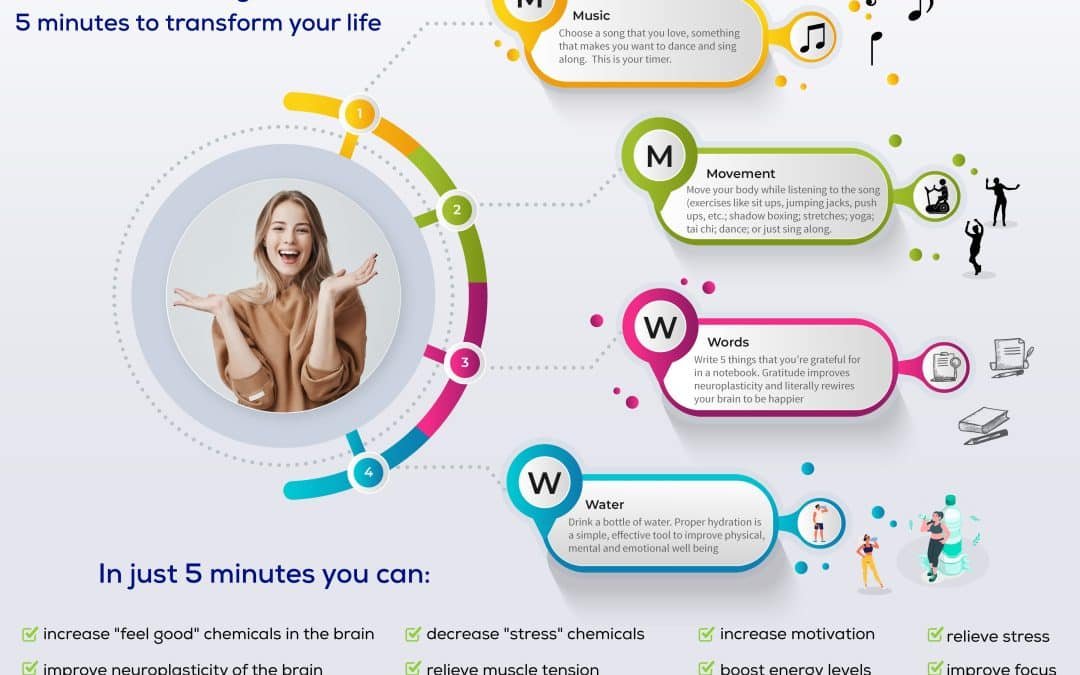
5 minutes to transform your life
5 minutes that will change your lifeWatch this short video on how to transform your life in just 5 minutes. Learn fun and easy ways to increase "feel good" chemicals and decrease "stress" chemicals so you feel happier and less stressed. Download your free MMWW poster...

Increasing happiness
What can I do to be happier? Emotions are chemical. There is a physiological reason why we feel the way we do. We have a reward center in our brain and when it is flooded by "feel good" chemicals (dopamine, serotonin, oxytocin, endorphins. etc.) we feel happy. We...

Building confidence and self esteem
Build confidence and self-esteem According to cognitive behavioral scientists our most basic questions are: Am I loveable? Am I worthy of love and belonging? Am I good enough? The answer is yes. Click on an image below to learn more. Here are five things that...

Family and relationships
Family and relationships Families matter. Marriage matters. Parenting matters. Healthy marriages and healthy families lead to happy lives and healthy communities. Learn tips how to have a better marriage and how to raise happy, successful children.Pediatric mental...

Stress management
Stress management Chronic worry and stress can negatively affect virtually every organ system in the body and has been shown to cause numerous health problems. Practical tips to manage stress Learn how worry and stress may be affecting your mental, emotional, and...

Help for Depression
Help for depression Discover how to overcome depression and anxiety naturally—without medication. Explore free healing tools, including videos, audio courses, eBooks, podcasts, articles, and even a full Healing Breathwork session with no strings attached. We genuinely...

17 Simple Ways to Relieve Worry, Stress, and Anxiety
17 Simple Ways to Relieve Worry, Stress, and Anxiety Worry, stress and anxiety can trigger a host of health problems, but there are things we can do to overcome the feelings of worry, stress, and anxiety. Here are 17 simple ways to relieve worry, stress, and...

How does worry and stress affect your health?
You Got This! Am I good enough? How do I stop worrying about my kids? How do I forgive myself? All these questions and more are answered in "You Got This!" "You Got This!" is a thoroughly researched, easy-to-read, well-designed action plan to calm feelings of fear,...

Emotional first aid kit
What is an emotional first aid kit? An emotional first aid kit is simply a list of emotional wellness tools that can provide an immediate, although temporary, positive effect on the way we think and feel. Having an emotional first aid kit readily available can...
5 Tips to Increase Happiness
Tip #1 Smile Why it works: Which comes first, the smile or the happiness? When people are happy they smile, but Charles Darwin first proposed the idea that it can also go the other way around in 1872 when he wrote, “The free expression by outward signs of an...

10 tips to overcome depression
Tips to help overcome depression If you're looking for practical tips to overcome depression, you've come to the right place. Learn what you can do yourself to overcome depression and anxiety naturally, without medication. Enjoy a free video series with useful...

Stop the Cycle – Generational Healing
Breaking the Cycle: Healing Generational Trauma, Abuse, and Self-Limiting Beliefs Many people try to change their lives but feel stuck. Even with strong effort and good intentions, the same struggles can repeat. You may promise yourself that you will not live the same...

Healing From Addiction With Breathwork
Healing From Addiction With Breathwork: A Simple and Powerful Path to Recovery Addiction is not a personal failure. It is often a sign that you are carrying deep pain.As Dr. Gabor Maté says, the real question is not “Why the addiction?” but “Why the pain?” Many people...

Healing Your Inner Child
Healing Your Inner Child A Transformative Breathwork Session for Deep Emotional Healing Your inner child holds some of your earliest memories, beliefs, wounds, and emotional patterns. When those early experiences go unhealed—whether from trauma, neglect, criticism, or...
The Secret to Confidence and Self Esteem
What is the secret to confidence and self esteem? Why is it that some people seem to have all the luck? Brimming with confidence, happiness and success they have a strong sense of love and belonging while other people, no matter how hard they try, are always wondering...
I Need Help, But I Can’t Afford It
I Need Help, But I Can’t Afford It Hope for healing—no matter your financial situationWhat If I Can’t Afford the Help I Need? When you’re struggling with anxiety, depression, trauma, or overwhelming stress, it’s normal to want help—but not everyone has access to the...
How to Heal from Childhood Abuse
Healing the Wounds of Childhood Abuse Some people assume we forget or outgrow trauma—but that simply isn't true. Childhood trauma doesn't just disappear with time. When left unresolved, it can manifest as lifelong emotional pain, mental health struggles, and even...
5 minutes to transform your life
5 minutes that will change your lifeWatch this short video on how to transform your life in just 5 minutes. Learn fun and easy ways to increase "feel good" chemicals and decrease "stress" chemicals so you feel happier and less stressed. Download your free MMWW poster...
Increasing happiness
What can I do to be happier? Emotions are chemical. There is a physiological reason why we feel the way we do. We have a reward center in our brain and when it is flooded by "feel good" chemicals (dopamine, serotonin, oxytocin, endorphins. etc.) we feel happy. We...
Building confidence and self esteem
Build confidence and self-esteem According to cognitive behavioral scientists our most basic questions are: Am I loveable? Am I worthy of love and belonging? Am I good enough? The answer is yes. Click on an image below to learn more. Here are five things that...
Family and relationships
Family and relationships Families matter. Marriage matters. Parenting matters. Healthy marriages and healthy families lead to happy lives and healthy communities. Learn tips how to have a better marriage and how to raise happy, successful children.Pediatric mental...
Stress management
Stress management Chronic worry and stress can negatively affect virtually every organ system in the body and has been shown to cause numerous health problems. Practical tips to manage stress Learn how worry and stress may be affecting your mental, emotional, and...
Help for Depression
Help for depression Discover how to overcome depression and anxiety naturally—without medication. Explore free healing tools, including videos, audio courses, eBooks, podcasts, articles, and even a full Healing Breathwork session with no strings attached. We genuinely...
17 Simple Ways to Relieve Worry, Stress, and Anxiety
17 Simple Ways to Relieve Worry, Stress, and Anxiety Worry, stress and anxiety can trigger a host of health problems, but there are things we can do to overcome the feelings of worry, stress, and anxiety. Here are 17 simple ways to relieve worry, stress, and...
How does worry and stress affect your health?
You Got This! Am I good enough? How do I stop worrying about my kids? How do I forgive myself? All these questions and more are answered in "You Got This!" "You Got This!" is a thoroughly researched, easy-to-read, well-designed action plan to calm feelings of fear,...
Emotional first aid kit
What is an emotional first aid kit? An emotional first aid kit is simply a list of emotional wellness tools that can provide an immediate, although temporary, positive effect on the way we think and feel. Having an emotional first aid kit readily available can...
5 Tips to Increase Happiness
Tip #1 Smile Why it works: Which comes first, the smile or the happiness? When people are happy they smile, but Charles Darwin first proposed the idea that it can also go the other way around in 1872 when he wrote, “The free expression by outward signs of an...
10 tips to overcome depression
Tips to help overcome depression If you're looking for practical tips to overcome depression, you've come to the right place. Learn what you can do yourself to overcome depression and anxiety naturally, without medication. Enjoy a free video series with useful...
Stop the Cycle – Generational Healing
Breaking the Cycle: Healing Generational Trauma, Abuse, and Self-Limiting Beliefs Many people try to change their lives but feel stuck. Even with strong effort and good intentions, the same struggles can repeat. You may promise yourself that you will not live the same...
Healing From Addiction With Breathwork
Healing From Addiction With Breathwork: A Simple and Powerful Path to Recovery Addiction is not a personal failure. It is often a sign that you are carrying deep pain.As Dr. Gabor Maté says, the real question is not “Why the addiction?” but “Why the pain?” Many people...
Healing Your Inner Child
Healing Your Inner Child A Transformative Breathwork Session for Deep Emotional Healing Your inner child holds some of your earliest memories, beliefs, wounds, and emotional patterns. When those early experiences go unhealed—whether from trauma, neglect, criticism, or...